

21 Mudroom Ideas for a Tidy, Welcoming Entry
These mudroom ideas can turn the messy spot by your door into a calm and tidy entry. A mudroom gives shoes, coats, bags, and keys a clear home instead of a pile on the floor. With a bench, a few hooks, and smart storage, even a small entry can work hard every day.
In this guide, you will find 21 mudroom ideas for every home, from simple bench setups to full built-in cubbies. Each idea comes with a photo to help you picture it in your own entry, and most of them work in rentals as well as owned homes. If your entry opens into a small living room, our small living room decor ideas show how to keep the whole space feeling open and calm.
1. Simple Mudroom Bench with Hooks Above It
A simple bench with hooks above it is the classic mudroom setup for a good reason. You get a seat for putting on shoes, a row of hooks for coats and bags, and storage underneath for the shoes that usually wander. This one setup solves three daily problems at once, so the entry stays clear with very little effort.

Choose a sturdy bench about 16 to 18 inches high, with hooks spaced 5 to 7 inches apart above it. Slide baskets underneath for gloves, hats, dog leashes, and the small things that need a home. Keep the bench about 15 to 18 inches deep, so it gives you a real seat without blocking the walkway.
2. Tiny Entryway Turned into a Mini Mudroom
You do not need a full room to enjoy a working mudroom at home. A narrow console or a slim bench, a few wall hooks, and vertical shoe storage can turn a tiny entry into a useful drop zone. The trick is to use the wall for storage instead of crowding the floor with deep furniture.

In a very narrow entry, skip the deep bench and pick a shallow shoe cabinet or a floating shelf with baskets below it. A mirror above the setup can make the space feel larger and gives you one last look before you leave. This approach suits apartments well, because it creates a mudroom feel without any remodeling at all.
3. Built-In Mudroom with Individual Cubbies
Built-in cubbies are hard to beat when a busy household needs a place for everything. Give each person a section with a hook, an upper shelf, and lower storage, so coats stop landing on the same chair. These mudroom ideas work best when each cubby fits the person who uses it, with room for a backpack or sports gear where it is needed.

Custom cubbies can be costly, especially once you add trim, paint, drawers, lighting, and professional fitting. For more built-in inspiration, see these mudroom design ideas before you plan your layout. Before you order anything custom, live with a temporary setup for a few weeks to learn what your family truly needs.
4. Narrow Shoe Cabinet Instead of a Bench
A slim shoe cabinet can be the smarter pick when a bench would stick out too far into the hallway. The tall, narrow shape keeps shoes contained while leaving more room to walk past. Closed doors also hide the clutter, which matters when six pairs of shoes somehow become nineteen by the front door.

Add hooks above the cabinet for coats and bags, or you will solve the shoe problem and create a backpack problem. Check the inside depth before you buy, because some slim cabinets only fit low-profile shoes. Tall boots and chunky sneakers need a cabinet with real clearance inside.
5. Mudroom Tucked Under the Stairs
The space under the stairs can become some of the most useful storage in the whole house. If your stairs sit near an entrance, the lower part can hold a bench, hooks, drawers, or even a small coat closet. These mudroom ideas make the most of an awkward slope, because every inch can be shaped around the stairs.

A simple bench and a few wall hooks can make the area work without a major building project. For more under-stair storage inspiration, see our staircase storage ideas before you plan the layout. Do not forget lighting, because a dark under-stair nook is hard to use without a small motion-sensor light.
6. Washable Mudroom Rug
A rug in a mudroom is not just decoration, because it has a real job to do every day. Pick a low-pile washable rug that can handle wet shoes and daily dirt without constant care. Light, high-pile rugs look pretty, but they belong somewhere far from muddy boots.

Size the rug to the traffic path, so people step onto it when they take off their shoes. A tiny rug that everyone walks around is worse than no rug at all. If the entry gets truly wet, put a tough mat just inside the door and save the prettier rug for farther into the room.
7. Personal Hook for Every Family Member
Personal hooks sound almost too simple, yet they are one of the easiest ways to improve a mudroom. Give each person one hook or a small section, and put kids hooks low enough that a backpack can go up without adult help. Labels with names or initials help, but a steady spot for each person works just as well.

Limit the number of hooks, because twenty hooks for a family of four will eventually hold twenty things. Keep one daily hook per person and store seasonal coats somewhere else. A mudroom stays easy to manage when winter jackets are not fighting summer hoodies for space.
8. Open Shelves Mixed with Closed Cabinets
A mudroom works best when open and closed storage share the job. Open hooks and shelves keep everyday items easy to grab, while closed cabinets hide cleaning supplies, extra shoes, pet gear, and the pile of reusable bags. The mix also keeps the room from looking too busy or too bare.

Put the least attractive storage behind doors and save open shelves for things that are useful daily or nice to look at. Pretty baskets and daily items stay within reach, while the messy necessities stay out of sight. This balance makes the entry feel calm even on a hectic morning.
9. Baskets for the Small Stuff
A mudroom can look tidy and still fail if tiny things have nowhere to go. Baskets earn their keep by giving each category its own home, from winter accessories and pet supplies to sports gear and reusable bags. Labels help when several people share the space, but a plain basket that is easy to grab often works better than a perfect system.

Smaller baskets beat one giant basket for small items, because a huge basket full of gloves becomes a black hole. For more basket storage inspiration, see our staircase basket ideas for clever ways to use baskets around the home. You do not need matching designer containers, since simple baskets at a good price do the same job.
10. Peg Rail for a Flexible Mudroom Wall
A peg rail is a smart pick when you rent or simply do not want built-in cabinets. The pegs can move along the rail as your needs change, so coats, bags, hats, umbrellas, dog leashes, and small baskets all find a spot. It also adds a little charm to a plain wall without needing a large piece of furniture.

Check your lease and use the right wall hardware for the weight you plan to hang. A rail holding two light tote bags is very different from one carrying five winter coats. Screw the rail into studs whenever you can, especially if kids will tug backpacks off it every morning.
11. Charging Station in the Mudroom
A charging station is one of those mudroom additions you do not miss until you have one. Phones, tablets, watches, and earbuds often pile up on the kitchen counter, so a small shelf with cable management near the entry gives them a home. A cabinet with an outlet inside can turn the mudroom into a true drop-everything station.

Keep the charging spot away from wet shoes and coats, and choose water-resistant surfaces with tidy cords. A simple cable box or a built-in pass-through makes the setup look planned instead of messy. This station helps most with kids who need devices charged overnight before school.
12. Modular Storage for a Mudroom That Grows
Modular storage gives you a middle path between a cheap bookcase and a costly custom mudroom. You can combine cabinets, shelves, benches, and baskets into a setup that looks far more built-in than a random set of furniture. The real win is flexibility, since you can take the system with you when you move.

Spend the most on the pieces that take the most abuse, like the bench and the shoe storage. Save on decorative extras and put the money where daily wear happens. Matching hardware and trim can make modular pieces look custom without adding expensive decor.
13. Vertical Storage for Boots and Tall Shoes
Boots are where many good mudrooms fall apart, because they do not stack neatly or fit standard shoe shelves. Wet boots need air to dry, so they need a plan of their own instead of a hopeful squeeze into a low cubby. A tall open shelf or a dedicated boot tray gives them a proper home.

Leave enough clearance around wet footwear so air can move instead of trapping damp inside a closed cabinet. Keep a boot tray right inside the entrance, so the where-do-wet-shoes-go question answers itself. This one habit protects your floor and keeps the entry from smelling damp.
14. Dog-Washing Station for Muddy Paws
A dog-washing station is a splurge, yet it is worth a thought if you are already renovating a mudroom. A small tiled wash area with a handheld sprayer can make rainy walks far less messy. Even without a full shower, a washable spot near the entrance helps a lot after muddy play.

Practical details matter more than a pretty photo here, so plan for good drainage, waterproof materials, and easy-to-clean surfaces. Leave enough room to move around the dog without bumping into walls. Keep towel storage within arm’s reach, or the station will not feel convenient at all.
15. Dark Paint for a Hardworking Mudroom
Not every mudroom needs to be white, and a darker color can actually work better in a hardworking entry. Scuffs and everyday marks show less on deep green, navy, charcoal, warm brown, or a muted earthy shade. A dark wall also makes the room feel grounded and calm instead of stark.

If dark walls feel like a big step, try the color on the cabinets or on one accent wall first. Always pick a durable washable paint finish, because this room sees more wear than most. Test the sample next to your floor and cabinets, since mudrooms often have less light than you expect.
16. Mudroom That Doubles as a Laundry Room
When space is tight, combining the mudroom and the laundry room can be smarter than building two separate rooms. A laundry room with a bench, hooks, shoe storage, and a counter can serve both jobs at once. You already have durable floors and surfaces built to handle mess, so the pairing makes practical sense.

Keep dirty laundry and outdoor gear visually apart as much as you can, and use cabinets to draw the line between them. For a laundry-mudroom combo that stays tidy, see our laundry folding tables ideas and these laundry mudroom design ideas for layout inspiration. A clear folding counter is one of the most useful features, so keep it free of clutter.
17. Mudroom Wall in the Garage
Not everyone wants muddy boots and sports gear coming into the main house. If your garage connects straight to the house, a mudroom zone there can be very practical. Durable wall storage, hooks, a bench, and heavy-duty bins can hold bikes, sports bags, gardening gear, and outdoor shoes.

Do not try to make the garage zone look like a magazine mudroom, because hardworking storage matters more here than delicate decor. Choose pieces that can take a beating and still look fine after a muddy season. Keep a small trash or recycling bin nearby for packaging and the random debris that gathers around garage storage.
18. Mirror in the Mudroom Entry
A mirror is a favorite mudroom addition, because it serves a real purpose without taking any floor space. A full-length mirror lets you check your outfit before you leave, while a smaller mirror above a bench can make a compact mudroom feel brighter. A vertical mirror suits a narrow room, since it draws the eye upward along the wall.

Place the mirror where it can catch natural or artificial light, so a dark entry feels brighter. Keep it clear of swinging backpacks and coats, or you will clean fingerprints off the glass every afternoon. Give the mirror a little breathing room and it will earn its place every day.
19. Curtain Instead of a Cabinet Door
A fabric curtain is a clever budget trick for hiding clutter under a bench. It costs less than building doors, adds softness to the room, and is easy to swap when your style changes. This trick suits cottage, traditional, Scandinavian, and casual rooms, though the right fabric can work almost anywhere.

Choose a washable fabric, because mudrooms are not kind to cloth. Mount the rod so the curtain just clears the floor, or it will collect every bit of dirt the mudroom was meant to contain. A simple curtain can make open shelves look tidy without any woodwork at all.
20. Drop Zone for Keys, Mail, and Essentials
A mudroom is not only about shoes and coats, since keys and mail need a landing spot too. A small shelf, tray, or wall organizer can hold keys, sunglasses, wallets, mail, and the things you grab on the way out. One clear drop zone works better than many tiny organizers that are hard to maintain.

Give each person a small basket or a set spot if several people share the entry. Put the key storage closer to the door than the decorative storage, because convenience decides whether people actually use the system. A tidy drop zone can end the daily hunt for keys before you leave.
21. Matching Materials for a Finished Mudroom
You do not need expensive cabinets to make a mudroom look finished and intentional. Repeat a few materials through the space, like the same wood tone, matching baskets, consistent hardware, or one paint color. The repetition ties cheap storage together and makes the whole area feel planned.
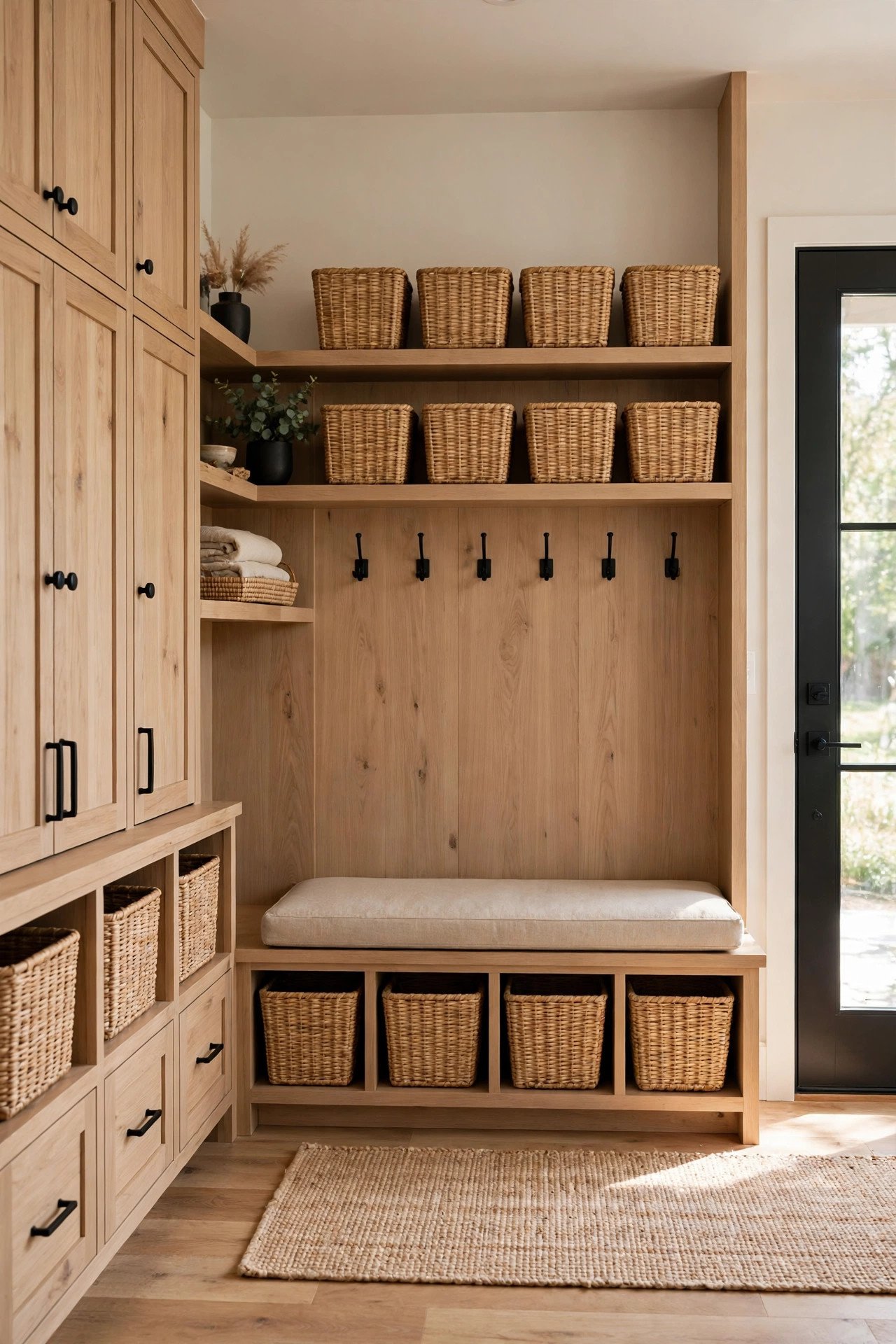
Practical rooms should still feel connected to the rest of the house, not like an afterthought. Spend the finishing money on good hooks, a quality bench cushion, or attractive baskets after the storage is in place. Install the functional pieces first, live with them for a week or two, and then buy only what you are truly missing.
FAQs
How much does a mudroom makeover cost?
A simple mudroom makeover can cost under 100 dollars when you start with hooks, a narrow bench, baskets, and a washable rug. A mid-range setup with modular cabinets, better shoe storage, and upgraded hardware usually runs from a few hundred to a few thousand dollars. A high-end renovation with built-in cabinets, drawers, and custom millwork can climb past several thousand dollars, especially with professional fitting.
What is the best mudroom storage for a small entry?
Wall hooks, a slim shoe cabinet, and one or two baskets cover most needs in a small entry. A narrow bench or a sturdy stool adds a seat without eating up the walkway. A washable runner and a small tray for keys finish the setup without crowding the space.
How do I start with mudroom ideas if I am on a budget?
Start with the pieces that solve a daily problem, because the best mudroom ideas begin with storage you truly need. Add sturdy hooks, a simple bench, and baskets before you spend anything on decor. Live with that setup for two weeks, then buy only the extras that your routine is still missing.
How do I keep a mudroom organized with kids?
Give each child one low hook and one basket at a height they can reach on their own. Keep only the current season coats at the door and store the rest in a closet. A boot tray by the entrance and a quick nightly reset keep the pile from growing again.
Do I need a separate room for a mudroom?
No separate room is needed, because a mudroom can be a wall, a corner, or the space under the stairs. A bench, a few hooks, and a shoe tray can create a working drop zone in almost any entry. The key is giving everyday items a clear home near the door you use most.
Final Thoughts
A good mudroom is not about a big room or a big budget, because it is about giving everyday things a clear home. Start by watching what actually lands near your door, then give those items a bench, a hook, or a basket of their own. The best setup is the one your family uses without thinking about it.
Pick one idea from this guide and try it this weekend, then add the next piece when you are ready. A tidy entry changes how the whole house feels the moment you walk in. Your door is ready to work harder for you, so start small and enjoy the calmer mornings.


